
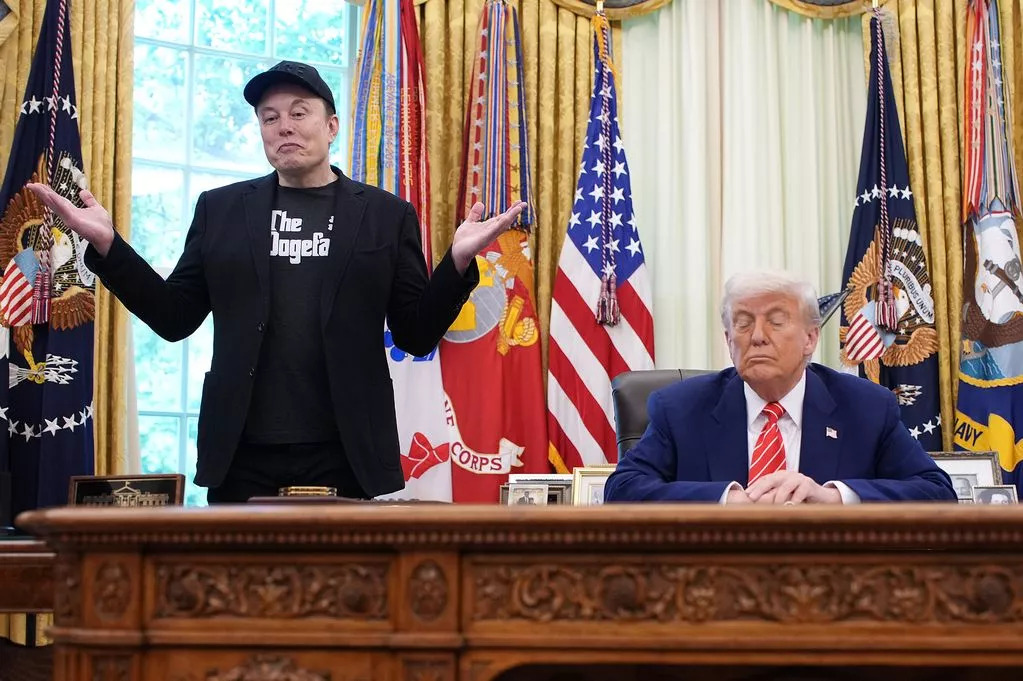
Washington, D.C. — What began as a simmering rivalry has now erupted into an all-out political and economic feud between President Donald Trump and Elon Musk — with Texas squarely in the crosshairs. The fallout from their increasingly personal and public clash threatens to disrupt federal contracts, commercial space operations, and a tightly intertwined web of political alliances that stretch from Capitol Hill to the Rio Grande Valley.
The latest salvo in the escalating battle ignited Thursday on social media. Trump, posting on Truth Social, took direct aim at Musk’s government-backed ventures, suggesting the federal budget could be slashed by “Billions and Billions” if Washington terminated SpaceX and Tesla’s government contracts and subsidies. Within minutes, Musk countered with a searing post on X — the platform he owns and operates from Bastrop — implying Trump’s name is in the sealed Jeffrey Epstein files. The billionaire then followed with a threat to decommission the SpaceX Dragon spacecraft, a crucial asset recently used to safely return two stranded NASA astronauts from the International Space Station.
Such a move would force NASA to seek space station access from Russia — a geopolitical and logistical nightmare for U.S. space policy. SpaceX, headquartered in Cameron County, Texas, is deeply embedded in NASA’s current human spaceflight program, and any disruption in operations could ripple across global space partnerships and national security interests.
But the stakes in this feud go beyond orbital dynamics. They run straight through Texas’ political and economic core. Musk’s major enterprises — Tesla, SpaceX, and the Boring Company — have all planted deep roots across the state, creating thousands of jobs and drawing billions in private investment. Musk’s influence has earned him strong ties to leading Texas Republicans, including Gov. Greg Abbott and U.S. Sen. Ted Cruz, who have repeatedly aligned with Musk on policy and oversight.
Cruz, who chairs the Senate committee that oversees commercial space and tech firms, has hosted Musk on his podcast and publicly backed his vision for privatized space leadership. Abbott, meanwhile, recently signed a law aimed at shielding companies like Tesla from shareholder lawsuits — a direct response to Musk’s ongoing legal battle in Delaware that helped spur the relocation of several of his companies to Texas.
Now, those same politicians are navigating a precarious balancing act. Trump’s grip on the GOP base remains ironclad, and distancing from him could mean electoral backlash. But alienating Musk could risk the state’s economic momentum and tech-driven aspirations.
Adding another layer of complexity is the America PAC, a super PAC Musk helped launch last year near Austin to funnel $260 million toward Trump’s re-election efforts. Its future now seems uncertain, as Musk’s rhetoric turns sharper and Trump continues to signal a willingness to sever economic ties.
While U.S. Sen. John Cornyn attempted to strike a measured tone, acknowledging Musk’s budget frustrations while suggesting Trump’s policies would ultimately prevail, the rift appears far from over.
What began as a power alliance between two titans — one of business and one of politics — has devolved into a high-stakes Texas showdown. With billions of dollars, aerospace supremacy, and political capital hanging in the balance, the Trump-Musk clash may not just alter campaign dynamics. It could reshape the economic and technological future of the Lone Star State.
The Washington Herald
editorial@thewashingtonherald.com
Washington, D.C.






Be First to Comment