
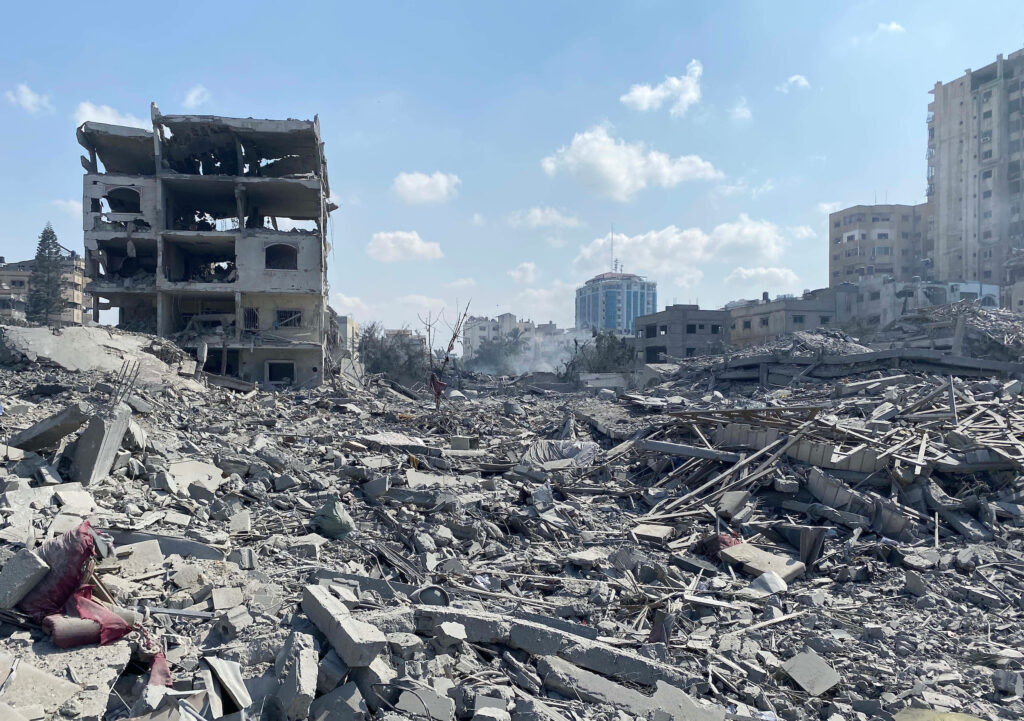
WASHINGTON, D.C. — Israel’s fragile ceasefire with Hamas in the Gaza Strip faced one of its most serious tests on Saturday as a wave of Israeli airstrikes killed at least two dozen Palestinians and wounded many more, according to health and civil defense officials in the enclave. Hospitals and emergency workers reported bodies pulled from collapsed homes, charred vehicles in city streets, and children among the dead and injured.
Israel’s military said the strikes were a response to what it called a grave violation of the truce: an armed Palestinian crossing an internal demarcation line into an Israeli‑held area of southern Gaza and opening fire on soldiers along a road used for humanitarian aid deliveries. No Israeli troops were reported hurt, but the army said the incident forced it to “begin striking terror targets in the Gaza Strip,” including in central and northern areas.
In the crowded Rimal neighborhood of Gaza City, a vehicle was hit on a busy street, killing several people and injuring many others. Hospital officials at Shifa said most of the wounded from that strike were children. Further south, strikes on homes near Al‑Awda Hospital in Nuseirat and in Deir al‑Balah left entire families buried in rubble, according to medical staff and local civil defence crews.
Gaza’s civil defence agency, which operates under Hamas authority, described the bombardment as a “clear violation” of the ceasefire and said at least 21 people were killed in five separate strikes, with the death toll expected to rise as rescuers combed destroyed buildings. Health officials later reported at least 24 fatalities and more than 50 wounded across the strip.
Residents reached by phone spoke of panic and confusion in neighborhoods that had cautiously begun to adapt to the uneasy calm since the October 10 truce. One man in Deir al‑Balah said he heard a huge blast and saw thick smoke covering the area before realizing that a nearby house’s top floor had been ripped away. His account matched testimony gathered by international reporters at the scene.
Israeli officials insisted they remain committed to the ceasefire but accused Hamas of repeated violations. Prime Minister Benjamin Netanyahu’s office said the latest strikes were aimed at “senior Hamas terrorists” and reiterated claims that militants have used the lull in large‑scale fighting to stage small‑unit attacks against Israeli forces inside Gaza. The army also reported separate incidents in Rafah and northern Gaza in which it said troops killed several armed men approaching Israeli positions.
Hamas, for its part, accused Israel of manufacturing pretexts to resume a broader war and urged the United States and other mediators to pressure Israel to fully implement the truce terms. The group said the recent pattern of limited strikes and incursions is creating a “de facto reality” on the ground that contradicts what was agreed with international brokers.
The escalation comes at a politically sensitive moment. Earlier this week, the U.N. Security Council approved a U.S‑drafted blueprint for Gaza that envisions an international stabilization force, a transitional civil authority, and an eventual pathway toward an independent Palestinian state. The plan, overseen by the Trump administration, is controversial on all sides: Israel’s government faces internal divisions over how much control to cede, while Palestinian factions argue over representation and long‑term sovereignty.
Meanwhile, the human toll of two years of war continues to mount. Gaza’s Health Ministry says nearly 70,000 Palestinians have been killed and more than 170,000 wounded since the conflict erupted in October 2023, figures the United Nations treats as broadly reliable. Israeli authorities say they have lost three soldiers since the ceasefire took hold and point to continued armed activity by Hamas and other groups as justification for targeted strikes.
On the streets of Gaza, the debate over ceasefire politics feels distant from the immediate struggle to survive. Families who had begun repairing damaged homes and reopening shops now face fresh displacement. Aid agencies warn that any return to sustained bombing would overwhelm hospitals that are already short on power, medicine, and staff and have been hit multiple times over the course of the war.
Diplomats say the next 24–48 hours will be critical. If the latest violence is contained to a brief exchange and negotiations continue, the ceasefire could limp on, though in a weakened form. If either side decides the truce is effectively dead, the region could slide back toward the kind of all‑out warfare that left much of Gaza’s urban landscape in ruins and destabilized politics far beyond the strip.
For ordinary residents, the calculus is brutally simple: they want the guns silent. Whether the ceasefire survives will depend less on official statements than on what happens in Gaza’s skies tonight and in the days ahead.
The Washington Herald
editorial@thewashingtonherald.com
Washington, D.C.






Be First to Comment