
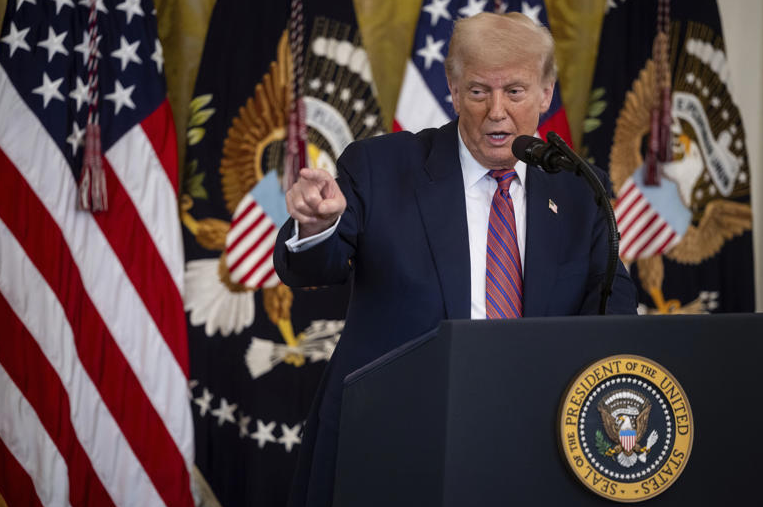
WASHINGTON, D.C. — President Donald Trump confirmed on Saturday that the Justice Department has formally requested the release of grand jury records related to the prosecution of Jeffrey Epstein, the late financier and convicted sex offender. The request, which is subject to court approval, signals a notable step toward public disclosure of sealed testimony from one of the most controversial criminal investigations in recent U.S. history.
In a post on Truth Social, President Trump acknowledged that the decision may not satisfy all critics, pointing to continued demands for broader transparency from political opponents and civil rights advocates. His comments follow a filing by the Justice Department on Friday indicating that certain redactions would be made to protect the identities of victims and other personal information not directly related to the case’s core proceedings.
Attorney General Pam Bondi and Deputy Attorney General Todd Blanche, who submitted the filing, have not detailed the scope of the redactions beyond referencing protections for personally identifiable information. The nature and extent of what remains shielded has already sparked renewed debate across party lines.
Support for releasing the grand jury materials has emerged from both ends of the political spectrum. Republican lawmakers including Representatives Thomas Massie (R-Ky.), Lauren Boebert (R-Colo.), and Marjorie Taylor Greene (R-Ga.) have joined Democratic colleagues in backing a bill that would compel the full public release of the Epstein records. The bipartisan push reflects broader frustration with longstanding secrecy surrounding Epstein’s connections and alleged associates.
The move by the Justice Department also comes in the wake of a recent Wall Street Journal report claiming that Trump, while a private citizen in 2003, sent a suggestive letter to Epstein that was later included in a birthday compilation organized by Ghislaine Maxwell. Trump has denied the letter’s authenticity and on Friday filed a $20 billion defamation lawsuit against the newspaper and its parent company, News Corp.
The court’s decision on whether to allow the release of the grand jury materials is pending. Should the request be approved, the records would mark the most comprehensive public disclosure yet in the Epstein investigation, a case that continues to ignite scrutiny of elite networks and accountability at the highest levels of power.
The Washington Herald
editorial@thewashingtonherald.com
Washington, D.C.




Be First to Comment